Tampilkan postingan dengan label announces. Tampilkan semua postingan

Kamis, 06 Desember 2012

Qualcomm announces two new Snapdragon S4 chipsets for China

Qualcomm announced two new Snapdragon S4 chipsets, which are optimized for the Chinese market. Both feature a quad-core CPU, Adreno 305 GPU and a transceiver that supports Chinese wireless networks.


The new Snapdragon S4 chipsets are called MSM8226 and MSM8626 and they pack a quad-core processor manufactured on a 28nm process (Qualcomm has reserved that for Krait cores), though the frequency wasnt announced. The CPU is paired with an Adreno 305 GPU. The chipset supports cameras up to 13MP along with 1080p video recording.


There's also a WRT2605 transceiver, which supports Dual-SIM, Dual Standby and Dual-SIM, Dual Active modes of operation and works on China-specific TD-SCDMA, CDMA 1xAdv and HSPA+. It also supports GPS, GLONASS and Beidou (Chinese equivalent of GPS). The radio chip is smaller and uses 40% less energy than its predecessor.


The Qualcomm MSM8226 and MSM8626 will sample in Q2 next year and will be available in Qualcomm Reference Design form too.


Source


Powered By WizardRSS.com | Full Text RSS Feed | Amazon Plugin Wordpress | Android Forums | Wordpress Tutorials


View the original article here


Eliana Adriana Chandra Buana


Kamis, 27 September 2012

LG announces the Optimus Vu successor, the Optimus Vu II

It's barely been six months since LG announced the awkward Optimus Vu and the company has already come up with a successor.


The Optimus Vu II, as it is called, comes with same 5-inch, 1024 x 768 resolution display and looks just as unwieldy as before. Now, however, there is a newer 1.5GHz dual-core Qualcomm MSM8960 from the Snapdragon S4 series ticking inside.


Other changes include 2GB of RAM, a slightly bigger 2,150mAh battery, IR blaster functionality to use the device as a wireless universal remote control, Miracast support, wireless charging and VoLTE capability. There seem to be some new software features as well but the poorly translated text from LG's Korean press release does a bad job of explaining them.


We wonder why LG would release a successor to a product that they launched so recently and with so few changes. Also, if it has anything to do with the launch of the Galaxy Note II today in certain markets around the world.


Source


Powered By WizardRSS.com | Full Text RSS Feed | Amazon Plugin Wordpress | Android Forums | Wordpress Tutorials


View the original article here


Eliana Adriana Chandra Buana


Kamis, 13 September 2012

Nikon announces the D600, the smallest and cheapest full-frame DSLR on the market

Looks like full-frame sensors are suddenly in vogue. Yesterday we saw a whole bunch of Sony cameras with full-frame sensors, including one camcorder. Now Nikon has announced the D600, which packs a full-frame sensor in what is the smallest, lightest and cheapest camera on the market right now.

The Nikon D600 uses a 24.3 megapixel 35.9 x 24mm full-frame CMOS sensor. The camera uses Nikon’s EXPEED 3 image processor and is capable of shooting at 5.5 fps.

Other features include ISO range of 100-6400 (expandable to IS 50-25,600), 39 point AF system, 0.13 second startup time, 1080p video recording in 30, 25 or 24 fps and 720p in 60, 50 or 30 fps, uncompressed video out via HDMI, dual SD card slots, HDR mode and a 3.2-inch, 921k dot LCD.

The Nikon D600 will go on sale on September 18 and will retail at $2,099 (body-only) or for $2,699 with the AF-S NIKKOR 24-85mm f/3.5-4.5G ED VR lens.

Source


Powered By WizardRSS.com | Full Text RSS Feeds | Amazon WordPress PluginHud 1 Settlement Statement


View the original article here


Eliana Adriana Chandra Buana


Rabu, 12 September 2012

Sony announces new RX1, NEX-6 and Alpha SLT-A99 digital cameras

Sony has announced three new cameras, the most exciting of which is the DSC-RX1 that was leaked a couple of days ago. The other two are the NEX-6, the newest member of Sony’s mirrorless interchangeable lens cameras, and the Alpha SLT-A99.

Let’s talk about the RX1 first. As was revealed before, the RX1 packs in a 35mm full frame sensor within a compact camera size body. The sensor is a 36 x 24mm EXMOR CMOS with a resolution of 24.3 megapixels. To go with that sensor, the RX1 has a fixed Carl Zeiss 35mm/f2.0 lens with dedicated focus and aperture rings.

Other features include a leaf shutter for near silent operation, dedicated exposure control dial, built-in flash with a hotshoe, ISO sensitivity up to 25,600 (extended to 102,400 using software tricks), RAW shooting mode, 1080p60 video recording and a 3-inch 1,229k dot LCD.

The RX1 will go on sale this November and will retail at $2,800.

Next is the NEX-6 that falls between the previously launched NEX-5N and the NEX-7. The new NEX-6 gets the Fast Hybrid AF, Wi-Fi and camera apps from the 5N and the high-resolution XGA OLED Tru-Finder viewfinder from the NEX-7.

On top of that it also has a 16.1 megapixel EXMOS APS HD CMOS sensor, electronic viewfinder, a new mode dial and hotshoe that were missing on the previous models, 3-inch, 921k dot tilting LCD, 1080p60 video and ISO sensitivity up to 25,600.

The NEX-6 will be sold in November for $1,000 with a SELP1650 compact 16-50mm F3.5-5.6 powered zoom lens and for $850 body-only.

Lastly we have the Alpha SLT-A99, part of Sony’s SLT range of cameras that look identical to a DSLR but have a fixed translucent mirror instead along with an electronic viewfinder. The A99 is the flagship model in this range and includes a full frame, 36 x 24mm, 24.3 megapixel sensor with built-in phase detection.

Other features include the world’s first dual AF system, with a 19-point main focusing system complemented by the 102 point focal plane phase detection AF on top of the camera’s sensor, 1080p60 video recording with mic and headphone jacks and FullHD video output through HDMI so you can connect an external recorder, a silent, programmable multi-control dial on the front, XGA OLED viewfinder, 3-inch, 1,229k dot articulated LCD with Sony’s WhiteMagic technology that adds an extra white subpixel along with the usual RGB for increased brightness outdoors and ISO 25,600 sensitivity.

The Sony Alpha SLT-A99 will be sold in October as body-only for about $2,800.

Source 1 • Source 2 • Source 3


Powered By WizardRSS.com | Full Text RSS Feeds | Amazon WordPress PluginHud 1 Settlement Statement


View the original article here


Eliana Adriana Chandra Buana


Kamis, 06 September 2012

Kobo announces new e-readers in an effort to one-up Amazon today

Kobo just went ahead today and announced a lineup of three spanking new readers. The Kobo Mini is a simple e-book reader, the smallest one available, as the company claims. The Kobo Glo is my favorite and it matches what Barnes&Nobles have with their glowing Nook SimpleTouch and what Amazon will soon have with their sidelit e-book Kindle, too. And finally, the Kobo Arc is a reboot of the Kobo Vox, the rather unsuccessful attempt of the company at making an Android tablet for multimedia consumption ala Kindle Fire.

Kobo is the smallest of three major online bookstore/ebook reader providers on the US market. And when you are that small, the best way to cast a shadow on your competitor’s announcement, is to go public with your products right after their announcement, not before it. That’s the way the internet rolls, newer stuff goes on top of older news. But, hey, what do I know, over at Kobo they probably read off their own marketing textbook. But I digress.

The three new readers will actually join the current KoboTouch ebook reader, so Kobo will have a total of 4 devices on sale. All the three new devices will become available this fall through “select retailers”, some of which include Indigo.ca, Futureshop.ca, Bestbuy.ca, and BestBuy.com. Pre-orders should be available very shortly.

Kobo’s current lineup without the new products

Kobo Glo

The Kobo Glo makes use of Kobo’s ComfortLight technology to let you read in the dark. It’s a regular 6-inch E Ink reader with a 1GHz Freescale processor and 2GB of built-in storage, expandable to up to 32GB via the microSD slot. The E Ink display has a resolution of 1024 x 768 pixels and can display up to 16 shades of gray scale. The promised battery life is one month, but without using the ComfortLight and the built-in Wi-Fi connectivity. The Kobo Glo will cost $130 and will be available in pink, blue, silver, and black.

Kobo Arc

The Kobo Arc is a 7-inch tablet that utilizes Android Ice Cream Sandwich and has full access to the Google Play store. Under the hood there is a 1.5Ghz dual-core TI OMAP 4470 processor and 1GB of RAM. It also has some sort of a custom interface called Tapestries. A front facing camera promises Skype video chat functionality.

The Kobo Arc will come in black or white (with optional interchangeable back covers) and it would sell for $200 for the 8GB version and $250 for the 16GB version.

Kobo Mini

Finally, the Kobo Mini is dubbed by Kobo as the “smallest e-reader on the market”. It has a 5-inch screen and weighs 134 grams. A 800MHz processor makes it tick, while the 2 gigs worth of storage are all you get for storing books. Battery life is rated at only 2 weeks. The devices has a touchscreen E Ink display and Wi-Fi connectivity.

The Kobo Mini will be available in black or white but thanks to interchangeable back, you will be able to personalize it in other colors as well (red, purple, and teal). The retail price for the eReader is equally diminutive at $80.

Source


Powered By WizardRSS.com | Full Text RSS Feeds | Amazon WordPress PluginHud 1 Settlement Statement


View the original article here


Eliana Adriana Chandra Buana


Rabu, 05 September 2012

Samsung announces Windows 8 based Series 7 and Series 5 AIOs

Samsung has announced three new members of the Series 7 and Series 5 range of All-in-One (AIO) desktop computers running Windows 8. The Series 7 includes a 27-inch and a 23-inch model whereas the Series 5 includes a 21-inch model.

All three models come with a 10-point multi-touch display that supports the full range of gestures you find in Windows 8. They also all have a resolution of 1920 x 1080.

The 27-inch model comes with a Intel’s third generation Core i7 processor 3770T processor, 8GB of RAM, discrete AMD Radeon HD 7850M graphics and 1TB hard drive. It’s priced at $1,699.

The 23-inch model comes with Intel Core i5 3470T processor with Intel integrated graphics, 6GB of RAM and 1TB hard drive. This one costs $1,099.

Finally, the 21-inch model (pictured above) has an Intel Core i3 processor with Intel integrated graphics, 4GB RAM and a 500GB hard drive. This one will set you back by $749.

All machines come with USB 3.0, Bluetooth 4.0, Wi-Fi, 1.3 megapixel front camera, wireless keyboard/mouse combo and Windows 8 64-bit. They will go on sale alongside Windows 8 on October 26.

Source


Powered By WizardRSS.com | Full Text RSS Feeds | Amazon WordPress PluginHud 1 Settlement Statement


View the original article here


Eliana Adriana Chandra Buana


Senin, 27 Agustus 2012

Samsung announces the Galaxy Player 5.8

If you thought the Galaxy Note was big, wait till you get a load of this. Samsung has just announced the new Galaxy Player 5.8, where 5.8 is not just a random number but actually the size of the display. This should dwarf even the display on the upcoming Galaxy Note II, which is rumored to be around 5.5-inch in size.

Surprisingly, though, for something the size of a small country, the display has a resolution of just 960 x 540, giving it a pixel density of 190 ppi. Samsung has also dropped their favorite Super AMOLED in favor of LCD technology for this panel.

Other details are rather sketchy at this point; we don’t even know what the back looks like. What we do know is that the Galaxy Player 5.8 will have Android 4.0 and a 2,500mAh battery. It will also be available in 16GB and 32GB variants (with microSD card slots) and black and white color options.

The pricing and launch dates are also unknown as of now but we’ll let you know as soon as we find out. Perhaps Samsung will provide more details at its upcoming August 29 event or at the IFA 2012.

Source


Powered By WizardRSS.com | Full Text RSS Feeds | Amazon WordPress PluginHud 1 Settlement Statement


View the original article here


Eliana Adriana Chandra Buana


Senin, 06 Agustus 2012

BLU announces the VIVO 4.3 dual-core, dual-SIM smartphone

Following the (large) footsteps of the Studio 5.3 Android smartphone BLU Products announced the VIVO 4.3. The Android Ice Cream Sandwich smartphone offers dual-core, dual-SIM functionality, to go with good looks and low price tag.


The BLU VIVO 4.3 features a dual-core Cortex-A9 CPU and MediaTek MT6577 chipset. The GPU is PowerVR SGX531. There's a gig of RAM and 4GB of built-in memory which can be further expanded via microSD card.


One of the most pleasant surprises in the BLU VIVO 4.3's spec sheet is the presence of a 4.3" Super AMOLED Plus display with WVGA resolution. An 8MP camera with 720p video recording, 1600mAh battery and customizable Android 4.0 Ice Cream Sandwich complete the highlights of the device's spec sheet.


The BLU VIVO 4.3 will hit the shelves of major US retailers in September, priced at the sweet $249.99 without contract. Latin America and parts of Asia will soon follow.


Powered By WizardRSS.com | Full Text RSS Feed | Amazon Plugin Wordpress | Android Forums | Wordpress Tutorials


View the original article here


Eliana Adriana Chandra Buana


Rabu, 25 Juli 2012

Toshiba announces REGZA T-02D Android smartphone for Japan

The T-02D is the latest in Toshiba's range of REGZA smartphones for Japan. This one comes with a 13.1 megapixel Sony EXMOR R BSI sensor and claims to go as high as ISO 25,600 equivalent ISO, although what kind of images you'll get at that sensitivity remains to be seen.


Other features on this phone include a dual-core 1.5GHz Snapdragon S4 processor, 1GB of RAM, 4.3-inch, qHD NEW AMOLED Plus display with Corning Gorilla Glass coating, fingerprint sensor, water IPX5/8) and dust-resistance (IPX5), 1,800mAh battery and Android 4.0.


The phone will be available on NTT DOCOMO network, starting July 26.


Source


Powered By WizardRSS.com | Full Text RSS Feed | Amazon Plugin Wordpress | Android Forums | Wordpress Tutorials


View the original article here


Eliana Adriana Chandra Buana


Minggu, 03 Juni 2012

LG announces new X Note Z350 Ultrabook

LG has announced the new X Note Z350 Ultrabook with a 13.3-inch display, which is the successor to the older Z330 model. It is based on Intel’s third generation Core i-series platform (Ivy Bridge) and boasts of a boot up time of only nine seconds.

Another feather in its sleek silver body is a Red Dot Design Award, even though it does sort of look like every other Ultrabook we have seen recently. LG also claims that it is the thinnest Ultrabook in the world, with a thickness of just 14.7mm. And at 1.2kg, it’s also very light.

Although the Z350 runs on the Intel Core i5/i7 processor, there is no mention of the GPU. It does, however, come with built-in SSD + HDD combo option. These are all the details we could glean from the awkwardly translated Korean press release but we’ll let you know if we get some more info.

Source


Powered By WizardRSS.com | Full Text RSS Feeds | Amazon WordPress PluginHud 1 Settlement Statement


View the original article here


Eliana Adriana Chandra Buana


Kamis, 10 Mei 2012

RIM announces mid-range BlackBerry Curve 9320

A few weeks ago RIM launched the cheap Curve 9220 in India. Today it announced the Curve 9320, which is pretty much the same phone, but with a few additional extras.


The Curve 9320 packs a 2.44 non-touch QVGA display, a four-row QWERTY keyboard, a 3 megapixel snapper with LED flash (in contrast to the 2MP in the Curve 9220), 512MB RAM and 512MB ROM, FM radio and microSD card slot.


The new BlackBerry Curve 9320 offers better connectivity options compared to 9220 in addition to the quad-band GSM and Wi-Fi connectivity, you also get GPS with A-GPS and 3G with HSPA support. The phone runs on the latest BlackBerry OS 7.1, comes pre-loaded with some social clients and has a dedicated BBM hardware key.


The pricing and availability info is yet to come.


Source | Via


Powered By WizardRSS.com | Full Text RSS Feed | Amazon Plugin Wordpress | Android Forums | Wordpress Tutorials


View the original article here


Eliana Adriana Chandra Buana


Kamis, 03 Mei 2012

Bang & Olufsen announces BeoPlay V1 LCD TV and BeoPlay A3 iPad speaker dock

Bang & Olufsen, more commonly known as B&O, has launched a new LCD TV called the BeoPlay V1. The best part about this set is the flexibility of its design that allows you to position it in multiple ways.

The TV has a unique mount for the stand that allows four different positions. One allows you to wall mount the TV, the other can be used to place it on the floor at a sufficient height so that it is approximately the same height as your seating position, the other places it at floor level with a tilt to point it towards you and the last one lets you hang the TV from the ceiling so it looks like it is suspended in mid-air.

Another great thing about this TV is that if you have an Apple TV, there is a compartment at the back where you can just slot it in so it’s out of sight and the TV comes with a universal remote that can also control the Apple TV. B&O also promises great audio quality from this set that we have come to expect from the brand.

The BeoPlay V1 will go on sale starting today and will be available in 32-inch (£1,999) and 40-inch (£2,499) models.

Next you have an awesome looking speaker dock called the BeoPlay A3. The advantage of this dock is that it allows you to position the dock in portrait as well as landscape mode. In landscape mode, it positions the iPad at a comfortable angle for watching movies or typing.

The dock has an interesting design with two of the adjacent sides being thin and the other two being thick and flat. The flat sides allow the dock to be placed on its side and the long thin side lets you type comfortably on the iPad.

The dock has three 0.5-inch tweeters and 2-inch woofers that are placed in such as way that no matter which position the dock is you always get the proper stereo sound. The dock intelligently switches between the speakers depending on how you place it. The A3 also has a built-in battery that is said to provide five hours of audio playback and can also charge the iPad when the dock is connected to a power source.

The BeoPlay A3 will go on sale on May 21 and will cost you £449. A white version is said to arrive later.

Source 1 • Source 2


Powered By WizardRSS.com | Full Text RSS Feeds | Amazon WordPress PluginHud 1 Settlement Statement


View the original article here


Eliana Adriana Chandra Buana


Senin, 30 April 2012

NVIDIA announces GeForce GTX 690

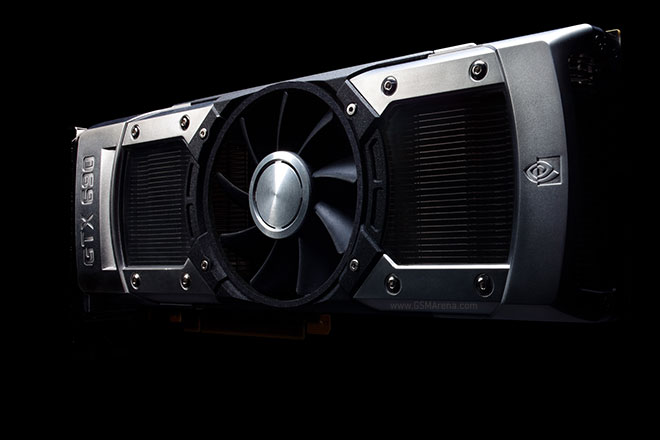
Nvidia announced its newest flagship graphics card at the NVIDIA Gaming Festival 2012 in Shanghai, the GeForce GTX 690. Combining two GTX 680s on a single card, the 690 is going to be one hell of a performer.

Combining two chips on a board is always tricky business and contrary to what one might expect the performance is not exactly double that of a single GPU card. In fact it’s usually less than the two cards running in SLi mode. But with the GTX 690, NVIDIA is aiming to get performance that will be equivalent to running two GTX 680 in SLi, while maintaining the convenience and lower cost of having a single card in your system.

The GTX 690 is double of everything. Twice the stream processors (2 x 1536), twice the texture units (2 x 128), twice the Raster Operations Pipeline (ROP) (2 x 32), twice the memory bus width (2 x 256-bit) and twice the VRAM (2 x 2GB). Thankfully TDP for the GTX 690 (300W) has not doubled over the GTX 680 (195W). The core and boost clock speed now stands at 915MHz and 1019MHz, slightly lower than 1006MHz and 1058MHz for the single GTX 680.

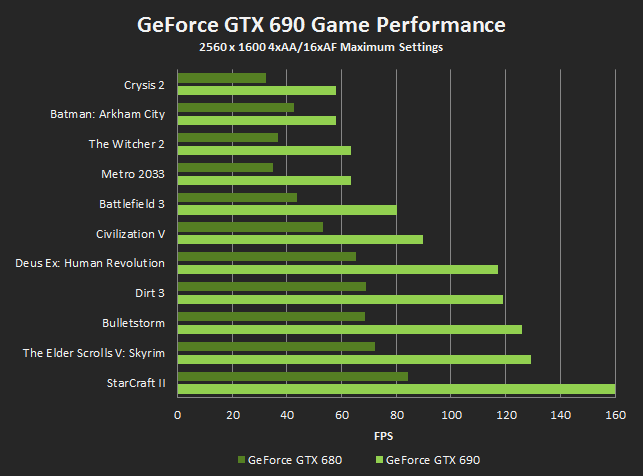
Unfortunately, we don’t have any reviews out yet for this card but if NVIDIA’s own scores are to be believed, the GTX 690 is on an average 75% faster than the GTX 680 in the same game.

But performance is not the only thing NVIDIA was after with the GTX 690. For the first time, a considerable amount of time and effort was also spent in improving the industrial design of the GPU. The design and the materials used take great inspiration from the engines of supercars and the outer shell in particular is made to look like an F1 car’s engine block.

But of course, looks aren’t everything and the design also has to be good at dissipating heat, especially on a dual-GPU card. For this, the 690 uses a pair of custom vapor chamber heat sinks cooled by a center mounted axial fan which should help keep the temperatures and sound levels down.

The GTX 690 will go on sale on May 3. Priced at $999, the GTX 690 costs exactly twice as much as the GTX 680 and is NVIDIA’s most expensive graphics card yet. Considering that the performance is roughly equivalent to dual GTX 680 in SLi, the pricing is appropriate. What little you lose in terms of performance you gain in terms of reduced power consumption and the convenience of having just one card inside your PC. We will still have to wait and see how well it performs in the reviews when they come out later this week.

Source


Powered By WizardRSS.com | Full Text RSS Feeds | Amazon WordPress PluginHud 1 Settlement Statement


View the original article here


Eliana Adriana Chandra Buana


Sabtu, 28 April 2012

ZTE announces quarterly results, misses analyst expectations

As you may recall, ZTE made some bold statements earlier this week, most notably involving ambitions to start shipping some 100 million smartphones annually by 2015. This goal now seems slightly less realistic, after they fell short of their forecast results for the first quarter of the year.


ZTE's biggest rival, crosstown manufacturer Huawei, reported a 53% decrease in its 2011 profits, despite a sales growth of only 11.7% and ZTE also noted similar trends.


Many analysts attribute these numbers to ongoing price wars between the two giants, as each strives to gain market share in China's competitive mobile economy.


Either way, ZTE is still slated to release a massive amount of devices in the coming years, if their MWC announcement extravaganza is any indication. We'll have to wait and see if they make you reach for your wallet anytime soon.


Source


Powered By WizardRSS.com | Full Text RSS Feed | Amazon Plugin Wordpress | Android Forums | Wordpress Tutorials


View the original article here


Eliana Adriana Chandra Buana


Rabu, 18 April 2012

Motorola announces XT390 dual-SIM droid for China Unicom

Motorola and China Unicom announced a new dual-SIM Android with unique design element. The Motorola XT390 offers dual-standby functionality and support for China Unicom's 3G network.


It runs Android 2.3 Gingerbread on an 800MHz processor and 512MB RAM. The screen is 3.5" big but the resolution wasn't mentioned in the press release (our guess is HVGA, judging by the screen's aspect ratio).


Motorola XT390 dual-SIM Android smartphone


Anyway, the XT390 can be had in either Black or Champagne gold and its 11mm thick body has an interesting asymmetric design element at the bottom.


The press release is in pretty poor English in this part, but we're pretty sure that the asking price for the Motorola XT390 is 1000 yuan (about $160), which is pretty cheap for a 3G dual-SIM droid.


Source


Powered By WizardRSS.com | Full Text RSS Feed | Amazon Script | Android Forums | Wordpress Tutorials


View the original article here


Eliana Adriana Chandra Buana


Microsoft announces names of the Windows 8 editions

Microsoft has released the list of editions that Windows 8 will be sold in. As of now, there will be four editions, Windows 8, Windows 8 Pro, Windows 8 Enterprise and Windows RT.

The first three will be available for PCs and tablet users running x86/64 processors and will be on sale whereas Windows RT will be exclusively for PCs and tablets running on the ARM platform and will not be sold but would rather ship built into the devices. According to Microsoft, all editions of Windows 8 offer a no-compromise experience, which has sort of become their slogan with Windows 8.

As you can guess, Windows 8 will be the base version meant for home users and is the equivalent of the Home Premium version of the current Windows 7. It will have all your basic features, including the updated version Windows Explorer, Task Manager, better multi-monitor support and the ability to change languages on the fly. You will be upgrade to this OS from Windows 7 Starter, Home Basic and Home Premium.

Windows 8 Pro will have all the features of Windows 8 but will add additional stuff such as encryption, virtualization, PC management and domain connectivity. You will be able to upgrade to this OS from Windows 7 Professional and Ultimate.

Windows 8 Enterprise will include all features from Pro and also “features for IT organization that enable PC management and deployment, advanced security, virtualization, new mobility scenarios, and much more”. This version will only be sold to corporations with Software Assurance agreements. This means if you are a regular consumer, you can only purchase Windows 8 or Windows 8 Pro.

Windows RT (RunTime), or WOA as it was known before, will be exclusively for devices running on the ARM platform. It will be optimized for touch and will come with touch optimized version of Microsoft Office built-in, unlike the other three editions. However, it will not allow the user to install any other application on the desktop side of the OS and the focus will be on using the Metro apps from the Windows Marketplace. Windows RT won’t have Storage Spaces or Windows Media Player built-in but will have device encryption. It will otherwise be similar to the base Windows 8.

Microsoft hasn’t announced the pricing yet but said that it will shortly. For more information, click on the source link below.

Source


Powered By WizardRSS.com | Full Text RSS Feeds | Amazon WordPress PluginHud 1 Settlement Statement


View the original article here


Eliana Adriana Chandra Buana


Selasa, 17 April 2012

Canon announces the 4K-capable EOS-1D C full-frame DSLR and EOS C500 cinema camera

Canon has gone on a 4K (4096 x 2160) frenzy unveiling two 4K-shooters – the EOS 1D C DSLR and the Cinema EOS C500 cinema camera.

Granted, 4K resolution monitors aren’t exactly a boom on the market just yet, but Canon is starting to give creatives the means to start creating for the new ultra high-resolution era.

So, let’s take a look at those babies, starting with the EOS-1D C. It is the first DSLR in Canon’s lineup capable of shooting 4K video at up to 24fps on its 18MP full-frame sensor. The 1D-C can record 8-bit 4:2:2 Motion JPEG 4K at 24fps or fall back to full HD recording at 24 to 60fps. Capturing from a 16:9 crop from the whole sensor is also available.

Naturally, you can output uncompressed 1080p through the camera’s HDMI port, but there are also dual CF slots, if needed. ISO sensitivity for video goes up to 25,600 in extended mode means you’ll get reduced noise and great quality in low-light environment.

Exact pricing of the EOS 1D C DSLR hasn’t been disclosed, but it’s expected to cost north of €10,000 with an October launch.

Now, onto the Canon Cinema EOS C500 4K professional camera. It supports both EF and PL mounts and is capable of shooting Raw 4K video footage with frame rates of up to 120 fps. It can also do 2K footage (2,048 x 1,080 pixels) at 12-bit with 4:4:4 Y’CbCr chroma sub-sampling.

Canon will showcase the EOS C500 camera at NAB on April 16-19 in Las Vegas, where video enthusiast can take a closer look at all of its 4K glory. Pricing and availability are not yet available.

Source, Source (2)


Powered By WizardRSS.com | Full Text RSS Feeds | Amazon WordPress PluginHud 1 Settlement Statement


View the original article here


Eliana Adriana Chandra Buana


Kamis, 05 April 2012

Panasonic announces LUMIX GF5 Micro Four Thirds camera

Panasonic has officially announced the LUMIX GF5 camera, which just like the other GF-series cameras that came before it, belongs to the Micro Four Thirds category. This compact, mirror-less camera comes with a new 12.1 megapixel Live MOS sensor and a redesigned Venus Engine processor. The GF5 is capable of shooting in sensitivities as high as ISO 12,800.

The LUMIX GF5 uses a sensor-based Contrast AF, which is said to be more accurate than Phase difference AF systems. It also offers full-area focusing, so you can set the auto focus at any point in the field of view instead of relying on pre-set points as seen on DSLRs.

The LUMIX GF5 is said to focus in 0.091 seconds and you can even use touch to focus on its 3.0-inch, 920k dot touchscreen display. Auto focus tracking ensures once you lock focus on an object by touching the display, the camera automatically tracks the object even if it moves.

The LUMIX GF5 also comes with Instagram-like image filters, fourteen of them, in fact. There is also a Scene Guide for newbie photographers that offers 23 sample images shot in various situations and lets you choose the one closest to your situation and then the camera adjusts all the parameters accordingly. As for video recording, the LUMIX GF5 can shoot up to 1080i videos in 60 fps in AVCHD.

The Panasonic LUMIX GF5 will go on sale later this year in black, white and red and will come with an option of either a 14-42mm standard zoom lens for $599 or a 14-42mm power zoom lens for $749.

Source


Powered By WizardRSS.com | Full Text RSS Feeds | Amazon WordPress PluginHud 1 Settlement Statement


View the original article here


Eliana Adriana Chandra Buana


close
//batas iklanmelayang----