Tampilkan postingan dengan label shows. Tampilkan semua postingan

Kamis, 27 September 2012

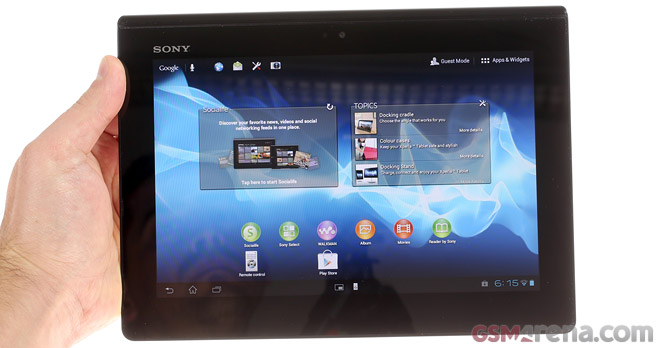
Sony Xperia Tablet S visits our office, shows its fold-over design and customized Android to our camera

The Sony Xperia Tablet S left its Sony HQ home to spend some time with us. It carries over some design elements from its predecessor, like the 9.4? WXGA screen and fold-over design, but it adds goodies like a quad-core processor (moving from Tegra 2 to 3), thinner aluminum frame and IPX-4 certification (splash proof).
The Xperia Tablet S is 8.8mm thick along its back, with a thicker “fold” on top. This makes the tablet easier to hold in the hand and is used to attach the tablet to various accessories.

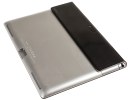
Sony gave us a suede cover to test, which also serves as a stand (it can hold the tablet tilted at two different angles). It snaps into place and will hold the tablet upside down, but we wouldn’t shake it too hard. When you close it, you can use the elastic band to keep it shut.

The tablet is available in 16GB, 32GB and 64GB versions, but the 16GB one will probably be the most popular as there is an SD card slot. That’s right, not microSD, but a regular-sized SD card slot, meaning you can expand the storage on the cheap.
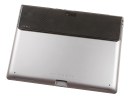
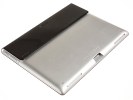
Sony Xperia Tablet S in our office

The top of the tablet houses an IR port, so you can use the tablet as a remote control. The included app is quite powerful and can even learn new commands directly from a remote control, if your appliance isn’t on the (quite extensive) list of presets.

The Sony Xperia Tablet S really feels like something intended for home use with the Remote control app. It even comes with a Small app version, so you can always switch the channel.

Speaking of Small apps, they are floating apps that take up only a part of the screen and can be used along side regular apps. You can see them in action in the video below.

We’re doing our complete review thing on the Sony Xperia Tablet S, so stick around if you want to learn more on the slate.


Powered By WizardRSS.com | Full Text RSS Feeds | Amazon WordPress PluginHud 1 Settlement Statement


View the original article here


Eliana Adriana Chandra Buana


Kamis, 16 Agustus 2012

An iPhone 5 mockup shows what the iPhone 4S should have looked like

According to its creators, what you see below is what the new iPhone 5 will look like. The beautifully looking render is made with a few reasonable points in mind. It has the same screen resolution as the iPhone 4/4S to save iOS some effort, a thinner body and a smaller connector.

Now judging by all those rumors, it’s all but guaranteed that the new iPhone will have a larger 16:9 screen, so chances are the guys from 3d-desk didn’t get it quite right. However you can’t deny that this is what the iPhone 4S should have looked like. By altering just a few elements (so it wouldn’t have increased production costs too greatly), this design still looks different enough to be easily recognizable and is cool enough to be worthy of a flagship smartphone.

Want to see it in action? Just check out the video below to get a feel of how the iPhone 4S could and should have been like.

We don’t know about you, but we wouldn’t mind seeing a similar dark frame and smaller logo on the real iPhone 5. Come on, Apple – at least think about it.


Powered By WizardRSS.com | Full Text RSS Feeds | Amazon WordPress PluginHud 1 Settlement Statement


View the original article here


Eliana Adriana Chandra Buana


Selasa, 07 Agustus 2012

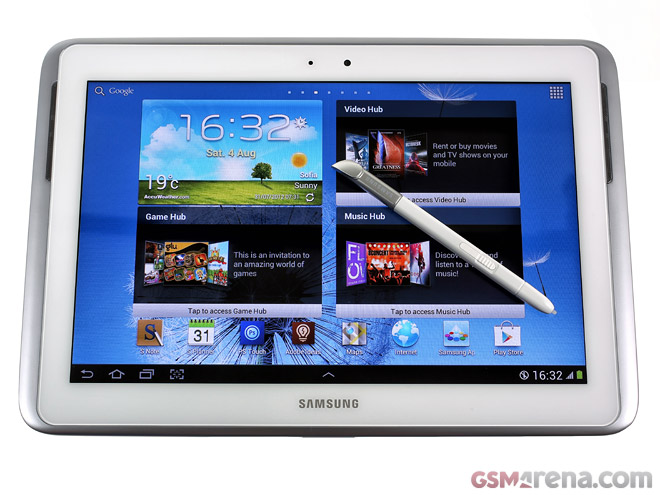
Quad-core Samsung Galaxy Note 10.1 finally lands in our office, shows what its capable of

The Samsung Galaxy Note 10.1 got off to a rocky start after its official announcement at the Mobile World Congress in Barcelona this year, after which it returned to the company’s R&D drawing board for a specs overhaul.

And several months later, here it is – the brand new Galaxy Note 10.1 with more powerful innards ready to take over the tablet scene. Or so it thinks.

Here’s a quick rundown. The Galaxy Note 10.1 is powered by the same Exynos 4412 chipset with a quad-core 1.4GHz processor and Mali-400MP GPU found in the Galaxy S III. And thanks to the 2GB of RAM, you get a truly multitasking-ready device.

However, the news aren’t so rosy in terms of screen. It’s a 10.1-inch PLS TFT screen with a resolution of 1280×800 pixels. Samsung are not using a Super AMOLED panel and the resolution is nowhere near FullHD.

Despite this little nitpick, the Galaxy Note 10.1 comes with a ton of useful features such as a microSD card slot, LED flash for the 5MP camera and 3G connectivity. At the front, there’s a 1.9MP camera for video chatting.

But the pièce de résistance of the Galaxy Note 10.1 is its special stylus called S Pen. With its help you can quickly write down notes, draw a funny picture or even make advanced modifications to a photo.

The latter is done thanks to the Adobe Photoshop Touch app, which comes for free on the tablet. It takes the Galaxy Note 10.1 to a whole new level, allowing professional as well as regular users to make photo adjustments while on the go.

Measuring 256.7 x 175.3 x 8.9 mm and weighing 583 grams, the tablet is going to find a comfortable place in nearly every bag and you won’t break any sweat carrying it around.

Samsung has thrown in almost everything its got in terms of software. The Galaxy Note 10.1 runs Android 4.0.4 Ice Cream Sandwich with TouchWiz 4.0 sprinkled on top. It adds really useful features to the stock Android experience like Mini apps, useful widgets and a few essential Samsung apps like S Memo, S Chat and more.

Check out our Samsung Galaxy Note 10.1 hands-on video below.

We are tirelessly working on the Galaxy Note 10.1 review, hopefully, you will be able to enjoy it in the coming days.


Powered By WizardRSS.com | Full Text RSS Feeds | Amazon WordPress PluginHud 1 Settlement Statement


View the original article here


Eliana Adriana Chandra Buana


Rabu, 09 Mei 2012

Kyocera shows tough Hydro and QWERTY-packing Rise ICS droids

Kyocera (who you might remember from the dual-screened Echo) has come up with a pair of tough Androids - the Hydro and the Rise. Both are CDMA phones and run Google's latest, Android Ice Cream Sandwich.


The Kyocera Hydro is a standard slab measuring 115 x 62 x 12.8 mm and weighing 120g. It has a 3.5" HVGA IPS LCD screen, a 1GHz processor (Qualcomm MSM8655 Snapdragon chipset) with 512MB of RAM, a 3.2MP camera, a 1,500mAh battery and a 2GB microSD card in the box (plus 2GB of built-in storage).


The Hydro has IP57 protection rating, which means it can survive under a meter of water for up to 30 minutes and withstand water jets.


The Kyocera Rise has pretty much the same specs as the Hydro, though it's slightly thicker at 113.0 x 60.5 x 14.3 mm and 157g of weight. The difference here is that the Rise slides open to reveal a four-row QWERTY keyboard.


It doesn't have the water-resistant rating though.


There's no info on pricing yet or which carries will get the two tough droids, but we know they are expected to go on sale in the second half of this year.


Source 1 Source 2


Powered By WizardRSS.com | Full Text RSS Feed | Amazon Plugin Wordpress | Android Forums | Wordpress Tutorials


View the original article here


Eliana Adriana Chandra Buana


close
//batas iklanmelayang----